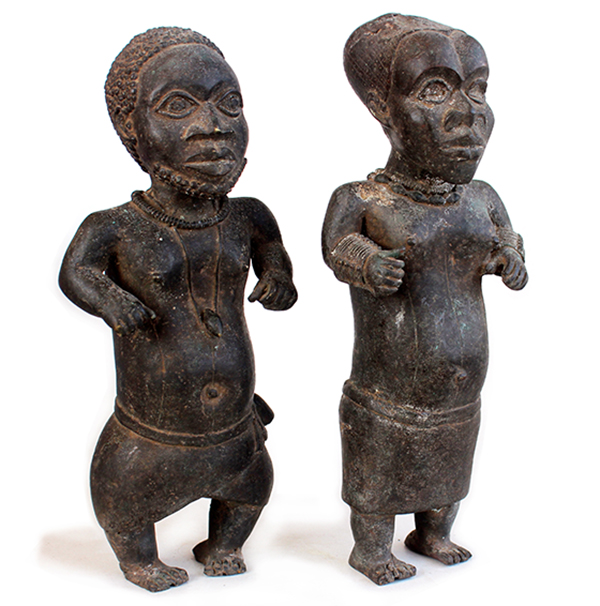
Depictions of small-statured people in old castings are very rare. They have never before been seen or mentioned in this size, 33 and 34 cm. One might venture the very tentative suggestion that, from around the 13th to the 18th century, only larger specimens measuring around 60 cm were produced for the court and its immediate circle, and that from then on the motif became affordable for the upper middle classes. It should be noted, however, that the term ‘middle classes’ is a European choice of words. However, if one compares the social structures, there was also a middle class and an upper middle class, even against the backdrop of slavery. This was similar to the situation in Europe at the same time, which, after all, also had serfs.
It is interesting, however, that this motif has survived for at least 700 years right up to the present day. One must assume that people of small stature held a particular social role. Here, too, one can only surmise that this role was more significant than simply that of a court jester. This is particularly so because the motif consists of a combination of female and male elements; one might therefore also assume a mythologised background.
The text here will probably be amended a few times following publication, as an additional thermoluminescence test is being carried out. The reason for this is as follows. The male figure has been dated to approximately 320 years old using the TL test, whilst no age could be determined for the female figure using this testing method. Both figures originate from the same workshop and both have an identical age-related patina.
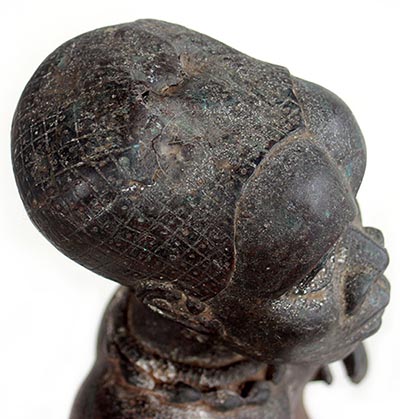
If bronze is heated to over 250°, the measurable casting core residues are reduced to zero. A figure of this size must have exceeded this temperature at the very least due to the visible repair at the back of the head. It was expertly repaired in the form of a kippa. The argument that this repair took place immediately after manufacture must be rejected, as a casting defect of this magnitude around 1700 can be ruled out. At that time, the alloy was as valuable as gold. It would therefore have been melted down and recast.
Virtually all the objects that have come onto the market since the mid-twentieth century up to the present day – the 2020s – originate from private Nigerian collections and were, for the most part, still ‘in use’ until shortly before they were sold. In other words, they served a function on an altar or were treasured as ‘family silver’. If such a figurine was damaged, it was repaired by a foundry belonging to the guild in Benin. It was not known at the time that the heat treatment would make subsequent analysis impossible.
|