Galerie Peter Herrmann |
- | Ancient Art from Africa |
||
 |
 |
 |
||
 |
 |
|---|
| Thermoluminescence - Expertise | Male Figure |
|
Nok-Culture, Nigeria |
| Edited in the net since may 2026 |
|
|---|
| Description |
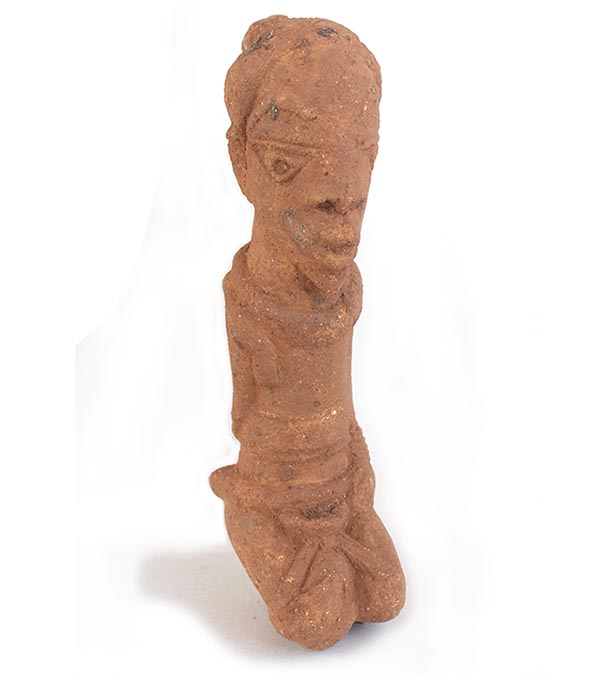
As of 2026, it is still very difficult to acquire ancient artefacts from the Nok culture, as some of the areas in Nigeria around Kaduna where these finds are made are controlled by the Boko Haram group. When researching the Nok culture, one constantly encounters allegations of looting, which presents a further difficulty. The truth is that these finds are mostly made by farmers who are careful whilst ploughing. In Nigeria, there is a lack of interest in purchasing such items, whether for scientific research or for collectors’ purposes, so the artefacts end up abroad. This accusation of theft can also be viewed as discrimination, as European-Western standards are applied which cannot be implemented in Nigeria’s reality. Without demand, a large proportion of these art treasures would simply have been ploughed under. As a dealer, one mitigates these contradictions by publishing images of figures such as this small male figure, in accordance with recommendations or legislation. Should any complaints arise, this makes it possible to address them. However, since the gallery began gradually exhibiting ancient African art from 1994 onwards, there have been no objections. On the contrary, many of the images of the figures and expert reports have appeared in discussion forums in Nigeria. |
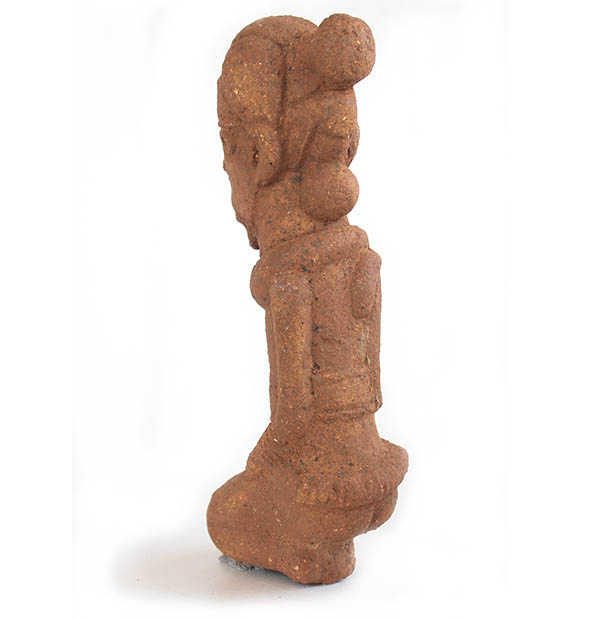 |
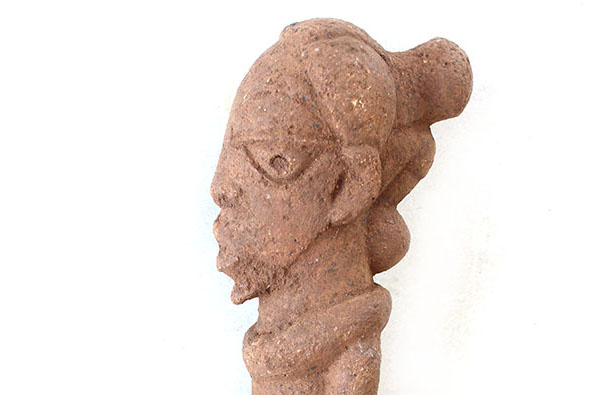
Many interesting details are clearly visible on this undamaged kneeling figure, as there is very little surface wear. A hip sash holds a wrap that lies across the thighs, displaying a large decorative knot. The headdress is unusual, covering only part of the back of the head. A knot is tied at the top like a bun and protrudes at the nape of the neck like a plait; however, this cannot be associated with the hair of the Negroid type found in the region today. A somewhat bold suggestion might be made regarding the Bororo further north in Niger, where men still wear long hair to this day. There are stylistic overlaps between the Nok and styles from Mali, and there, in turn, Berbers with straight hair still reside alongside the Tuareg. Nor are the large ears Bantu in origin. An even bolder suggestion is a reference to Nilotic kinship. Two thousand years ago, vast swathes of the Sahara were steppe, and there was a lively caravan trade to East Africa and via Egypt as far as West Asia. In China, black slaves from what is now Iran were being purchased as early as 5,000 years ago. The left arm, adorned with numerous bracelets, rests on the thigh, whilst the right arm is bent and holds a round, movable object draped over the shoulder. The goatee, nose and the distinctive rendering of the eyes, set well to the sides, are characteristic of the Nok style. |
 |
Translated with DeepL.com |
|
 |