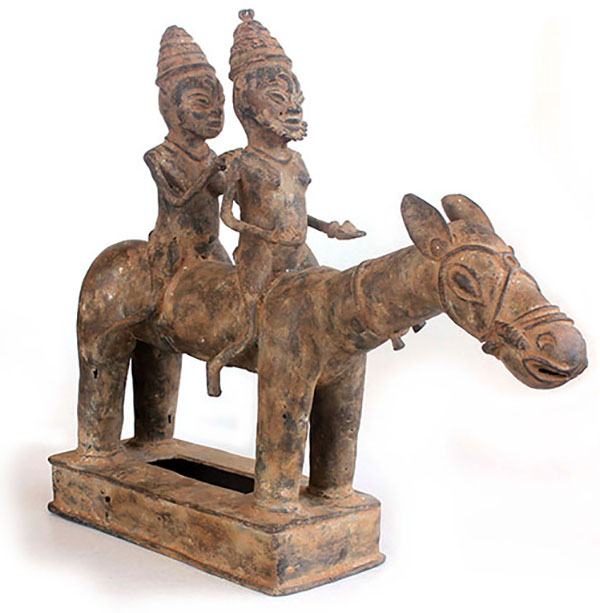
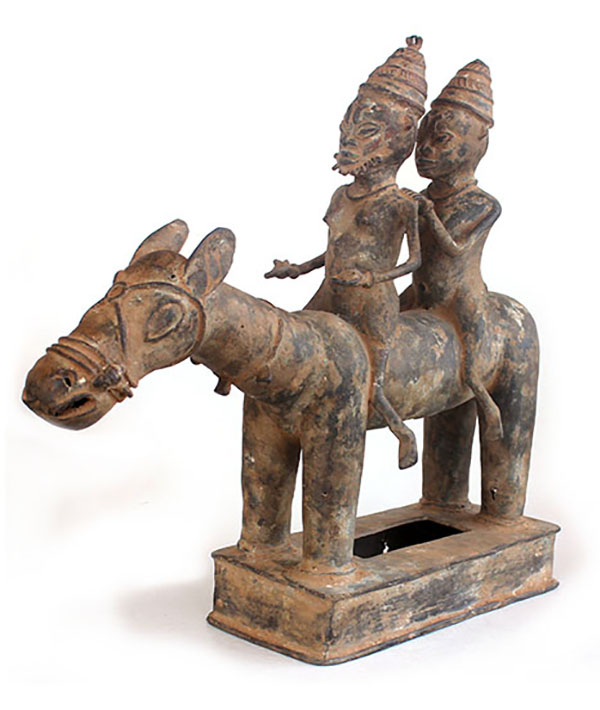
There are works of historical art that even a connoisseur would not immediately recognise as old. Depictions of non-abstract nude figures in dynamic poses are very rare and are almost always classified as motifs produced for tourists in the second half of the twentieth century. One has to know one’s dealers very well indeed to be able to believe them when they claim a piece is ‘old’. Such claims are made far too frequently. After a close examination of the weathering and patina, the decision was made to commission a laboratory analysis.
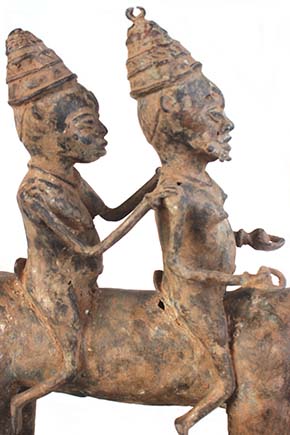
The man, who is holding the reins that no longer exist, still has two stirrups in his hand, which allude to this. Behind him sits a woman who has placed both hands on his shoulders. Judging by her breasts, she is a young woman, presumably pregnant. Their only clothing consists of striking hats and necklaces. The hairstyle visible at the back of her head is cut short and without adornment. The man has a goatee. The two faces are rendered realistically, whilst the rest of the figure is depicted in a slightly stylised manner. Both are seated on a saddle that is not laced from below, which in the original was presumably made of simple leather and fabric in the style of the northern Hausa. Due to climatic conditions, the Muslim-influenced equestrian culture lies north of the Yoruba ethnic border. |
 |